The Vocabulary cloze passage component is one of the most challenging components of the PSLE Paper. From Primary 5, students have to face filling in 15 blanks with appropriate grammar or vocabulary. Even students confident in English language cringe as they lose countless marks in this component.
More and more, the Primary 4 students are faced with vocabulary cloze passages during their examinations. With little practice in school, P4 students can find this component daunting, even if it is just 5 marks.
Preparing our P4 students to manage cloze passages, as well as Synthesis and Transformation at Thinking Factory, is an important part of our Primary 4 curriculum. Laying a good English foundation in their P3 and P4 years by teaching them the correct rules and techniques, will help them as they move on to P5 and P6.
While cloze passage is challenging, there is a method to this madness. Reading a variety of materials is a good way to recognize idiomatic expressions and phrasal verbs found in such cloze passages.
Students will also need to be able to identify contextual clues (antonyms, similar words, nouns, adverbs, etc) from the passage.
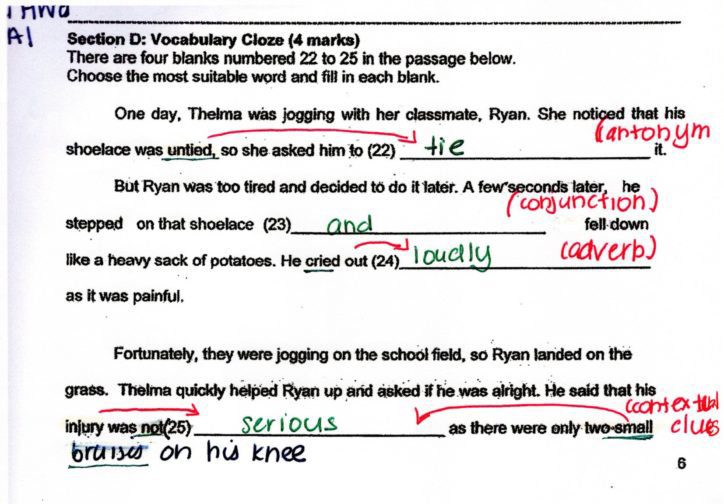
Example of a cloze passage taken from a Primary 4 SA1 paper
Students should read the vocabulary cloze passage in its entirety first before attempting to find their contextual clues. We also remind them to highlight words or phrases in their passage that are clues to their answers.
They should also be able to identify what they are supposed to fill in the blank with and write it down next to the blank. While this step may require more time, it is an important part of managing the vocabulary cloze section.
For answer 22, the clue is ‘untied’. The answer is the antonym of untied which is ‘tied’.
For answer 23, a conjunction is needed to join the two clauses together and the conjunction is ‘and’
For answer 24, the clue is ‘cried’ and the student needs to fill in the blank with an adverb. The most suitable adverb is ‘loudly‘.
For answer 25, the contextual clues are ‘not’ and ‘small bruises’. The best answer is ‘serious’.
Vocabulary cloze passages may get more difficult as the primary 4s move up to P5. However, with a good foundation and knowledge, students will feel more confident when tackling this component.
var kadenceConfig = {"screenReader":{"expand":"Child menu","expandOf":"Child menu of","collapse":"Child menu","collapseOf":"Child menu of"},"breakPoints":{"desktop":"1024","tablet":768},"scrollOffset":"0"};
var SUShortcodesL10n = {"noPreview":"This shortcode doesn't work in live preview. Please insert it into the editor and preview on the site.","magnificPopup":{"close":"Close (Esc)","loading":"Loading...","prev":"Previous (Left arrow key)","next":"Next (Right arrow key)","counter":"%curr% of %total%","error":"Failed to load content. <a href=\"%url%\" target=\"_blank\"><u>Open link<\/u><\/a>"}};