Setting goals has always been a habit that is encouraged. As adults, we constantly set goals for ourselves throughout the year, be it for work, family, or simply for ourselves.
So, should children set goals as well?
Goal setting is a great way to instill in children a sense of purpose and even determination. Most importantly, by consciously planning out their goals, children can visualise what they want to achieve and the steps needed to get there.
In previous years, my P6 students would do their Goal Setting after their P6 SA1 papers. This would be the start of their motivation for the rest of the hectic 4 months before the PSLE. However, with the elimination of the full SA1 this year, the goal setting will take place after the P5 SA2. This week marks our P5 classes will begin on their P6 revision. A great way to begin would be to get them to reflect on what they would like to achieve for their PSLE English and what actions they can take to get to their goal.
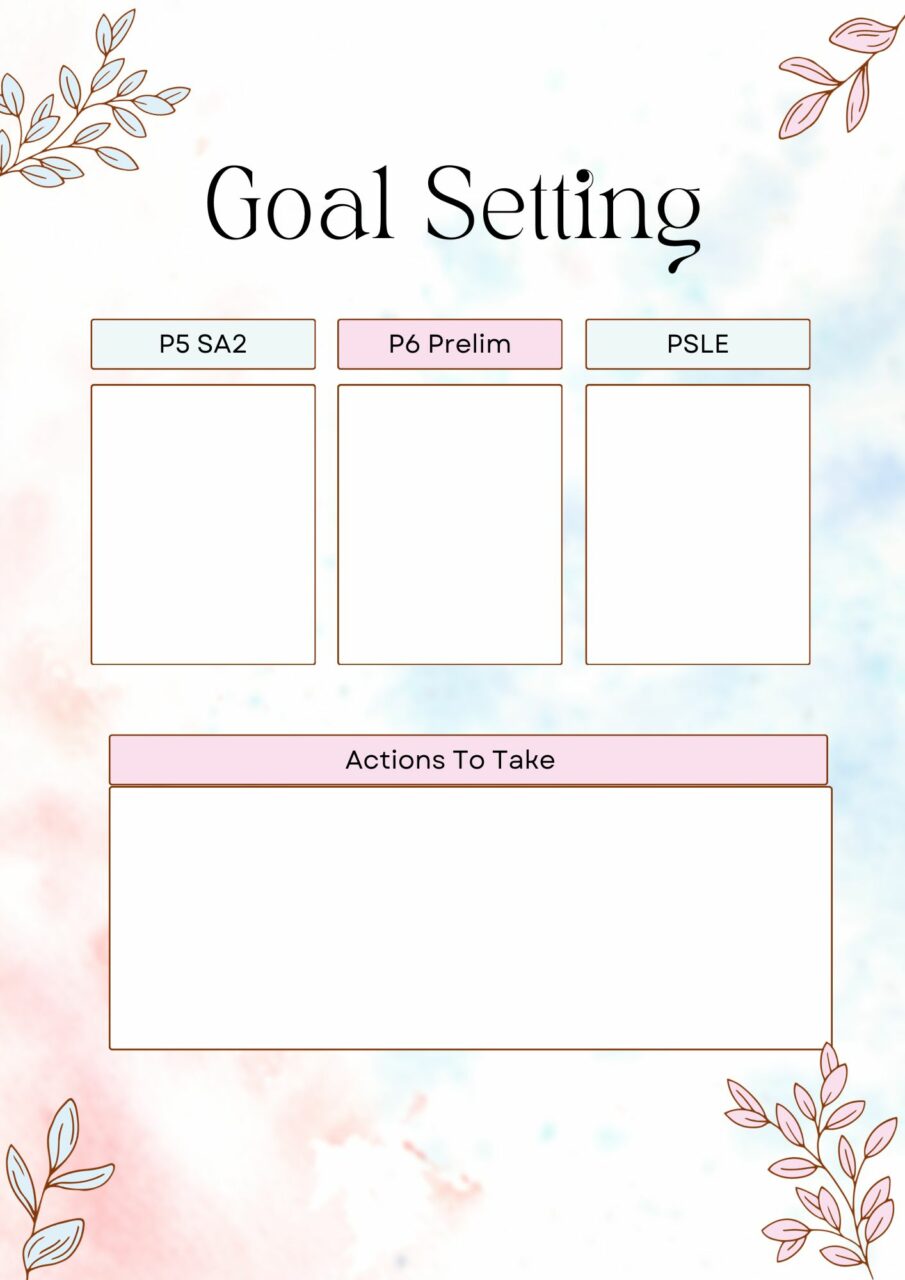
Students can reflect on how much they hope to score for each component of the English paper after they get their full SA2 results.
In previous years, at the end of the goal-setting exercise, I was happy that most of the students took it seriously and reflected on what they wanted to achieve in their Preliminary exams and the PSLE and the steps that they would like to take to achieve their goals.
This goal-setting exercise can also be done at home with your child of any age. You can download the chart that I have created. Here are the steps that I took with my P6 students to set their goals
1. Let them choose their goals
I did not tell my students what I wanted them to score for their English Prelim or PSLE. Each student was told to set their own goal. The only reminders that I gave them were to reflect carefully and be realistic in what they set. For students who had already scored their AL1 for the English SA1 in previous years, I reminded them that maintaining that score for both prelim and PSLE would require hard work and perseverance as well.
2. Break the goal into smaller steps
I broke up their English AL goal into smaller steps by breaking down the English components – Oral & LC / Paper 1 / Paper 2. This made the goal less overwhelming and more manageable with short-term steps.
When focusing on the component they scored the least in for their SA1, my students in previous years, were able to add on more actions that they needed to take for that particular component while listing fewer actions for the component that they scored the highest in.
3. Set realistic Actions to take
I made sure that my students listed out realistic actions to take to achieve their goals. Revising 10 hours a day over a weekend, for example, is not only unrealistic but can be a cause for burnout before the PSLE. By setting realistic goals like putting away all devices for 4 hours a day over a weekend and focusing on revision work, a student is more likely to find this manageable and feel like what he or she is doing can lead to success.
4. Encourage & Motivate
The purpose of this exercise is not to belittle or overburden the student. The PSLE is enough stress for a 12-year-old child to handle. Creating the goal-setting exercise was a way to let my students know that they too are in control of what they want to achieve and to take ownership of the fact that they can help themselves improve.
In my experience, the PSLE year can be stressful. School homework will be increased and students will be faced with several non-stop examinations stretched out over the second half of the year. While some students thrive on stress, others may simply be overwhelmed and give up trying, just waiting for the PSLE to be over.
At the end of the goal-setting exercise, I reminded my students that while achieving their goals for their English Preliminary is a good thing, they should not feel disheartened if they don’t. The most important thing is that they put in their effort and practise the actions that they listed.
Check the other articles from this section
- PSLE English Paper 1
- SOTA Primary 6 Creative Writing Competition 2021
- Phrases to describe pride and embarrassment
- P6 English Composition model: Being punished
- Creative Similes – How to use them and score in your PSLE compositions
- P6 2021 SA1 List of Composition Themes
- P6 Composition Being Late
- List of P6 2020 English composition Preliminary Themes
- List of 2018 PSLE Compo themes
- PSLE Composition Reminders
- List of 2022 Preliminary Themes
- PSLE 2022 Paper 1 : Unpacking the Situational Writing Component
- Phrases to describe ‘A Narrow Escape’
- PSLE English 2022 Paper 1: Check what AL1 and AL2 English scorers wrote about
- 4 ways to score in the PSLE 2023 Composition & a Model Composition on the theme of ‘A change for the Better’
- List of 2023 Preliminary Composition themes & model on ‘kicking a bad habit’
- List of 2021 Preliminary Composition Themes
- PSLE English Composition tips: Two ways to plot ‘An unexpected discovery’ & model composition
- P6 English Composition: 3 ways to help students score above 33 for their examinations
- 2022 English Prelim and Composition Model – A change in attitude
- Primary 6 Composition A dangerous situation
- P6 Composition Theme Something Unexpected that Happened to You
- P6 SA1 2018 List of Composition Themes
- PSLE Composition A Crime you were involved in
- P6 Situational Writing
- PSLE English Composition Theme – A Considerate Act
- P6 Composition An Adventure
- 2019 Preliminary Composition Themes
- P6 English Composition A Secret
- P6 Model composition – A Dangerous situation
- Primary 6 English Composition: A Changed Behaviour & PSLE 2019 results
- P6 SA1 Composition Themes 2019
- P6 Writing: City Underground & SOTA Primary 6 Creative Writing Competition 2020
- P6 English: An unforgettable event composition
- P6 Composition A Memorable Occasion & taking risks in plots
- PSLE Composition Theme An Unusual Incident
- P6 Composition model on Achieving a goal & how to score well
- P6 English Composition model An Unwelcomed Guest
- 2024 PSLE Preparation Advice from top scorers
- PSLE English Paper 2 tips and guides
- P6 Paper 2 Grammatical Rules
- P6 Paper 2 Who vs Whom
- Synthesis and Transformation – PSLE 2020
- List of Editing Spelling words PSLE 2017-2020
- P6 English Paper 2 components – Contractions in Question Tags and Synthesis & Transformation
- P6 English Paper 2: Phrasal Verbs & Commonly misspelled words
- Synthesis & Transformation – What are Interchanging Word Classes?
- Synthesis & Transformation – Interchanging word classes & Lists of Adjectives/Verbs to Nouns
- PSLE 2021 Editing Component – Three Ways to help your child succeed in this component
- 4 Steps to ace your Active and Passive questions in Synthesis & Transformation
- PSLE Editing world List CA1 Top School 2016 Papers
- P6 CA1 Vocabulary List 2016 (Part 1)
- P6 Top School SA1 Vocabulary List 2016
- P6 Top School SA1 Editing List 2015
- Vocabulary List Preliminary Papers 2015
- P6 SA1 Editing List 2016 – Part 1
- Primary 6 CA1 Vocabulary List 2016 (Part 2)
- P6 CA1 Vocabulary and Editing List 2017
- Primary 6 English Comprehension Cloze Passage
- Primary 6 Vocabulary List
- P6 Editing Spelling CA1 2015
- Primary 6 English Vocabulary and Editing List 2019
- 2017 Preliminary Top School Papers: Vocabulary & Editing
- P6 List of Vocabulary words taken from the Top School CA1 papers 2018
- PSLE English Paper 3
- PSLE English Paper 4
- PSLE Oral stimulus-based conversation – Healthy eating model
- Oral – 3 Tips for Reading Aloud
- PSLE ORAL – P6 2021 SA1 Oral Themes
- P6 Oral Common SBC Questions (part 1)
- PSLE Oral – Water Conservation
- Primary 6 Past PSLE Stimulus-based Conversation Oral Questions
- List of 2020 Preliminary Oral themes Part 2
- 2020 List of Preliminary Oral Themes Part 1
- P6 Preliminary Oral Questions 2016
- PSLE Oral – Unpacking the 2022 PSLE Oral
- 2023 Preliminary Oral Themes & tips to answer the questions
- P6 Oral : List of 2022 SA1 Oral Themes
- List of 2022 Preliminary Oral Themes
- Stimulus-based conversation model PSLE 2020 Day 1
- 2021 P6 SA1 English: List of Preliminary Oral Themes & how you can use the list to help you
- 6 PSLE Oral tips to help you score well
- English Oral model A Birthday Party P6
- P6 English Oral model Holidays
- PSLE English Oral model Food
- PSLE Oral Reminders
- Preliminary Oral Topics 2015 & 2016
- Common Stimulus-Based conversation questions to prepare for PSLE Oral
- P6 Oral model Food & CA1 Results 2017
- P6 English Oral model Newspapers
- PSLE Oral Practice health
- PSLE English Oral model Family
- PSLE Oral: Stimulus-based conversation key questions 2020
- PSLE Oral themes and questions to help your child practice at home
- P6 SA1 Oral Theme and Questions 2016 (Part 1)
- Preliminary Examinations 2015 Oral Topics
- List of PSLE Oral Themes 2019
- 2019 List of PSLE Oral Themes
- 2019 Preliminary Oral Topics
- P6: List of Stimulus-based conversation questions 2016-2018
- PSLE Oral Gadget Addiction
- PSLE English Oral Practices – Recycling, Saving water and Volunteering
- PSLE English Oral model Children’s Day
- 2018 Preliminary English Oral Themes
- 2018 PSLE SA1 Oral Themes
- P6 English Oral model Science Fair
- PSLE Stimulus-based Conversation Dance class model answer
- P6 Oral Stimulus-based Conversation – Kindness
Don’t Miss Any Future Post!
2024 P6 English Tuition Timetable
| Branch | Day | Time |
|---|---|---|
| Bukit Timah | THU | 3 pm to 5 pm |
| Bukit Timah | THU | 5 pm to 7 pm |
| Bukit Timah | SAT | 1 pm to 3 pm |
| Bukit Timah | SAT | 3 pm to 5 pm |
| Hougang | WED | 5 pm to 7 pm |
| Hougang | FRI | 3.30 pm to 5.30 pm |
| Hougang | SAT | 1.30 pm to 3.30 pm |
| Virtual branch* | FRI | 5.30 pm to 7.30 pm |
